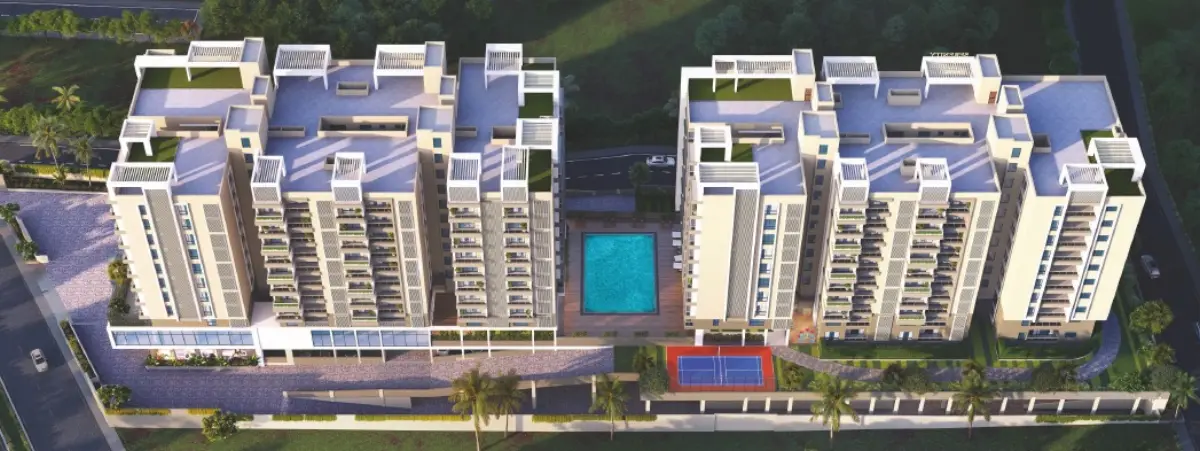
Once you move into a flat in Hubballi (Hubli) or Dharwad, you pay a monthly charge to the apartment owners' association for security, housekeeping, lifts, common lighting and water. Whether GST is added to that bill depends on two limits: how much the association charges each member, and how large its total collections are. Most smaller buildings fall outside GST altogether. Large gated complexes with higher charges often do not.
This guide covers GST on maintenance after you move in. For GST on the price of an under-construction flat, see GST on under-construction flats.
The two tests
Maintenance collected by a residents' welfare association from its own members for common use is exempt from GST up to ₹7,500 per month per member. The Central Board of Indirect Taxes and Customs (CBIC) explained the rule in Circular 109/28/2019-GST of 22 July 2019. The limit was ₹5,000 until 24 January 2018 and has been ₹7,500 since 25 January 2018, under entry 77(c) of the services exemption notification.
GST at 18% applies only when both of these are true:
| Association's annual turnover | Monthly charge per member | GST due? |
|---|---|---|
| More than ₹20 lakh | More than ₹7,500 | Yes, 18% |
| More than ₹20 lakh | ₹7,500 or less | No |
| ₹20 lakh or less | More than ₹7,500 | No |
| ₹20 lakh or less | ₹7,500 or less | No |
The circular says an association with aggregate turnover of ₹20 lakh or less in a financial year does not need to register or pay GST "even if the amount of maintenance charges exceeds Rs. 7500/- per month per member". A June 2026 summary by Taxscan describes the same two limits and the 18% rate, so the position is unchanged in 2026.
Once it applies, the whole amount is taxed
This is the point that surprises most owners. According to the circular, if the charge exceeds ₹7,500 a month, "the entire amount is taxable". Its own example: a ₹9,000 monthly charge attracts 18% on the full ₹9,000, not on ₹1,500.
A Madras High Court single judge took a different view in 2021, holding that only the amount above ₹7,500 is taxable. A division bench of the same court stayed that ruling in September 2021 (Bar & Bench). A 2025 Business Today report quoting a tax firm described the excess-only ruling as applying in Tamil Nadu, without mentioning the stay. Either way, a Madras High Court ruling is not binding on authorities in Karnataka. Until a higher court settles it, expect associations in Karnataka to follow the circular.
The limit is per flat
If you own two flats in the same complex, the ₹7,500 limit applies to each flat separately, the circular says. Two flats at ₹7,000 a month each, ₹14,000 in all, attract no GST.
Worked examples
| Association | Monthly charge | Annual collections | GST each month |
|---|---|---|---|
| 60 flats at ₹3,500 | ₹3,500 | ₹25.2 lakh | Nil: charge is within ₹7,500 |
| 15 flats at ₹9,000 | ₹9,000 | ₹16.2 lakh | Nil: turnover is within ₹20 lakh |
| 120 flats at ₹9,000 | ₹9,000 | about ₹1.3 crore | ₹1,620 (18% of ₹9,000) |
| 120 flats at ₹7,600 | ₹7,600 | about ₹1.09 crore | ₹1,368 (18% of ₹7,600) |
The last two rows show the cliff. An association that raises its charge from ₹7,500 to ₹7,600, just ₹100 more, adds ₹1,368 of GST to each member's bill, because the whole ₹7,600 becomes taxable. Over a year that is ₹16,416 per flat. Associations near the limit should weigh this when they set the budget, and members can raise it at the general body meeting.
When the builder collects maintenance
Until the association is formed and takes over, the builder may run the building and collect maintenance, sometimes many months in advance; in the case below it was 18 months. The ₹7,500 exemption is written for an association supplying its own members, so it does not cover a builder.
In an order dated 28 September 2026, the Maharashtra Authority for Advance Ruling held that a developer's 18 months of advance maintenance and its monthly maintenance were both taxable supplies, that GST on the advance was due on receipt, and that the ₹7,500 exemption "is not applicable because the Applicant is a promoter and not an RWA" (Vardhaman Homes order). An advance ruling binds only the applicant and that state, but it shows how GST officers see the question. When you budget, assume 18% GST on any maintenance the builder bills, and check the cost sheet; our hidden costs guide and handover checklist list what to ask.
What the association can claim back
A GST-registered association can take input tax credit for GST it pays on capital goods such as generators, water pumps and lawn furniture, on goods such as taps and pipes, and on services such as repair and maintenance, the circular confirms. That credit reduces the GST it has to pay over, which in turn can keep the charge down.
Is the limit going to change?
Not so far. In September 2025 the Bangalore Apartments' Federation petitioned the Centre to abolish the 18% GST on maintenance or raise the ₹7,500 limit, calling it arbitrary (Deccan Herald). As of November 2026 we found no notification changing the limit or the rate.
Checklist for owners
- Ask the association its monthly charge per flat, its annual collections, and whether it is GST-registered.
- If GST is charged, check that the invoice shows the association's GST number.
- If you own two flats, check that the ₹7,500 test is applied to each flat.
- For a new flat, ask the builder in writing how much maintenance is collected in advance and whether GST is added. Our guide to apartment owners' associations in Karnataka explains how and when the association takes over.
The exemption is written for members of a housing society or residential complex. If you also let the flat out, the maintenance you pay is not deducted separately from rent for income tax; see tax on rental income. This is general information, not tax advice.
Sources
- Circular No. 109/28/2019-GST: GST on monthly subscription/contribution charged by a Residential Welfare Association — Central Board of Indirect Taxes and Customs, accessed 26 November 2026
- GST on RWA maintenance charges: threshold, exemption and ITC rules (23 June 2026) — Taxscan, accessed 26 November 2026
- Madras High Court stays single-Judge ruling on GST exemption for RWA contributions up to ₹7,500 (13 September 2021) — Bar & Bench, accessed 26 November 2026
- GST on apartment maintenance: A tax firm clears the air on ₹7,500 rule confusion (17 April 2025) — Business Today, accessed 26 November 2026
- Advance ruling No. GST-ARA-54/2022-23/B-157, M/s. Vardhaman Homes (28 September 2026) — Maharashtra Authority for Advance Ruling (via GST Council), accessed 26 November 2026
- Bangalore Apartments’ Federation seeks GST waiver on maintenance (4 September 2025) — Deccan Herald, accessed 26 November 2026
Written by the Shriya Properties team in Hubballi and checked against the sources above on 26 November 2026. Rules, rates and prices change — confirm the current figures before you decide. Spotted something out of date? Tell us.
Questions buyers ask
Is GST applicable on apartment maintenance charges?
Only if the charge is more than ₹7,500 a month per member and the association’s annual turnover is more than ₹20 lakh. Then GST is 18%.
Is GST charged on the full maintenance or only the amount above ₹7,500?
On the full amount, according to CBIC Circular 109/28/2019-GST. A 2021 Madras High Court single-judge ruling that taxed only the excess was stayed by a division bench.
If I own two flats, does the ₹7,500 limit apply to each?
Yes. The circular says the limit applies separately to each flat you own in the complex.
Is GST payable on advance maintenance collected by the builder?
Generally yes, at 18%. The ₹7,500 exemption is for an owners’ association, and a 2026 Maharashtra advance ruling held that it does not apply to a developer collecting maintenance.